Zone 2 Cardio for Fat Loss After 40: Heart Rates by Age, and Why It Can Take About Twice HIIT's Minutes
Zone 2 is 60–70% of an age-based estimate of your maximum heart rate, which works out to about 95–127 bpm between ages 40 and 70 for men and women. The window drops 2–3 beats every five years, so recheck it as you move up an age band.
After 40, your zone 2 target is a heart-rate window.
For zone 2 cardio for fat loss, that window is 60–70% of an age-based estimate of your maximum heart rate. Between ages 40 and 70 that works out to about 95–127 beats per minute (bpm) for men and women. When total calories burned are matched, zone 2 and HIIT (high-intensity interval training) give similar fat loss in many studies, per PNOE.
The cost is time: by one PNOE estimate, zone 2 can take about twice HIIT’s minutes to burn the same calories.
Check first: MedlinePlus advises talking with your health care provider before you start exercising, especially if you have trouble moving or balancing.
What zone 2 is: 60-70% of your maximum heart rate
The Minnesota Bariatric Center defines zone 2 cardio as exercise at 60–70% of your maximum heart rate. It also calls it low-intensity steady-state (LISS) exercise. Your maximum heart rate is the fastest your heart can beat during an all-out effort. Few people know theirs, so an age formula stands in for it.
Samitivej Hospitals gives two formulas: 214 − (0.8 × age) for men and 209 − (0.7 × age) for women. Neither one needs a lab or a treadmill test. You only need your age.
Your zone 2 range: about 95–127 bpm from age 40 to 70
The table runs both Samitivej formulas through the 60–70% band. Here is the method for one age:
Age 50, men: 214 − (0.8 × 50) = 174 bpm max per Samitivej Hospitals; 174 × 60% = 104 and 174 × 70% = 122, so zone 2 = 104–122 bpm per the Minnesota Bariatric Center’s 60–70% band.
| Age | Men’s max (bpm) | Men’s zone 2 (bpm) | Women’s max (bpm) | Women’s zone 2 (bpm) |
|---|---|---|---|---|
| 40 | 182 | 109–127 | 181 | 109–127 |
| 45 | 178 | 107–125 | 177.5 | 107–124 |
| 50 | 174 | 104–122 | 174 | 104–122 |
| 55 | 170 | 102–119 | 170.5 | 102–119 |
| 60 | 166 | 100–116 | 167 | 100–117 |
| 65 | 162 | 97–113 | 163.5 | 98–114 |
| 70 | 158 | 95–111 | 160 | 96–112 |
Ranges are rounded to the nearest beat. Two patterns show up that neither source states:
- At every age shown, the men’s and women’s ranges are never more than 1 beat apart. Partners of a similar age can share a row.
- The window drops 2–3 beats every five years. Recheck your row as you move up an age band, or run the formula for your exact age.
The Minnesota Bariatric Center uses a simpler formula, 220 minus your age, which gives lower numbers at older ages. At 70 that is a max of 150 and a zone 2 of 90–105 bpm, against 95–111 in the men’s row. If your numbers differ from the table, check which formula produced them.
These numbers are an estimate from your age, not a measurement of your own heart. If you’d rather judge effort by feel, the zone 2 talk test for people over 40 works for anyone.
A zone 2 session runs 20–60 minutes; start at 20–30
Start short. The Minnesota Bariatric Center suggests starting with 20–30 minutes, three to four times a week. Samitivej Hospitals gives 20–40 minutes in zone 2. BodySpec’s ruck walk runs 40–60 minutes.
Put those three ranges in order and you get a way to build up:
- Rung 1: 20–30 minutes, three to four times a week, while the effort is new.
- Rung 2: up to 40 minutes, once the starter sessions feel easy.
- Rung 3: 40–60 minutes for a longer session, such as the ruck walk below.
For your weekly total, see how much zone 2 cardio per week over 40.
Two sessions for this week: a bike ride without joint impact, and a brisk walk
Session 1: the steady bike ride (start here). BodySpec says to keep your pedal speed steady and set the resistance so your breathing gets deeper but stays under control. Pedal speed is called cadence and is counted in revolutions per minute (RPM). BodySpec describes the ride as continuous effort without joint impact. Ride 20–30 minutes to begin.
Check your heart rate against your table row, and ease the resistance if you go above it.
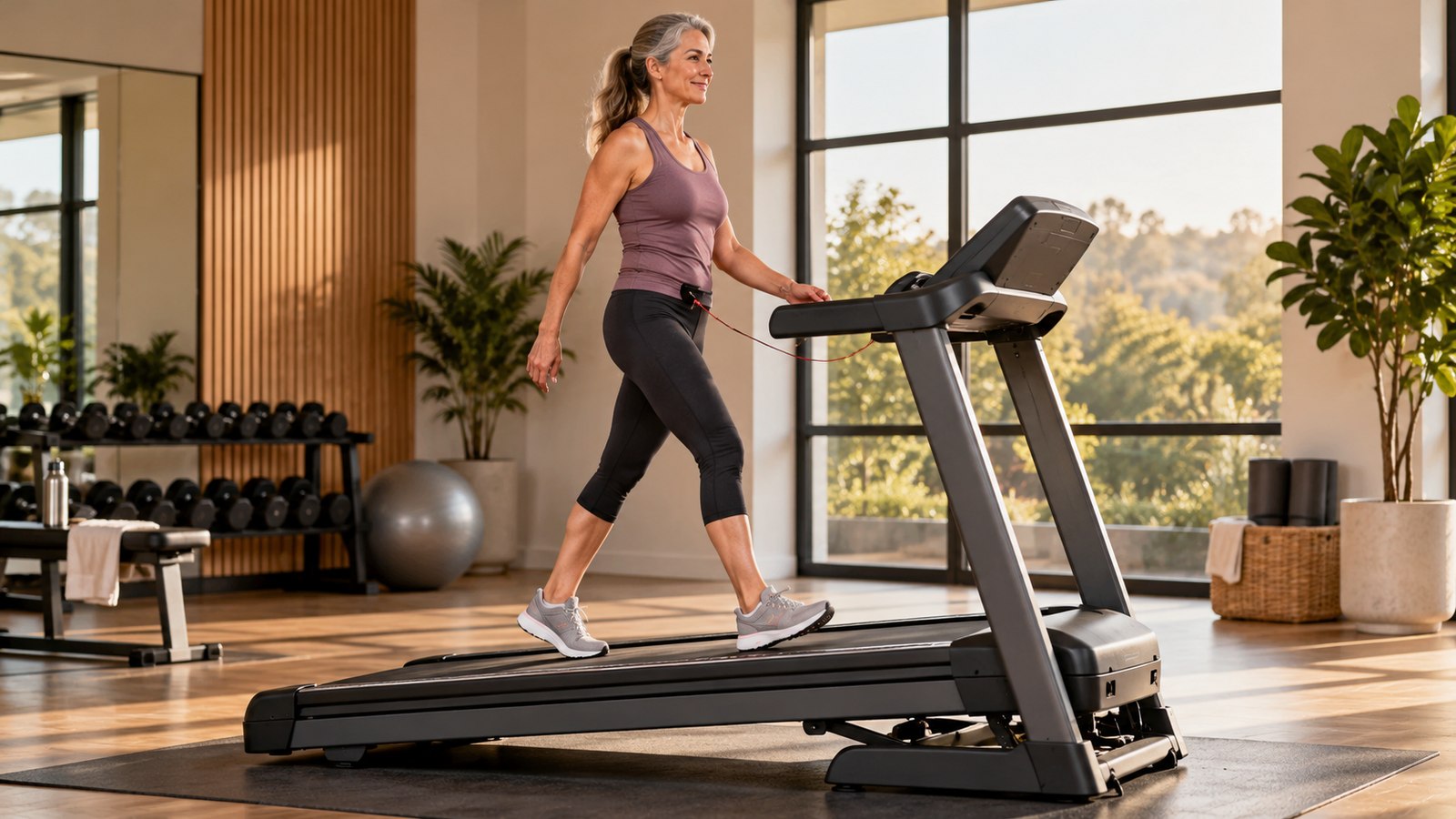
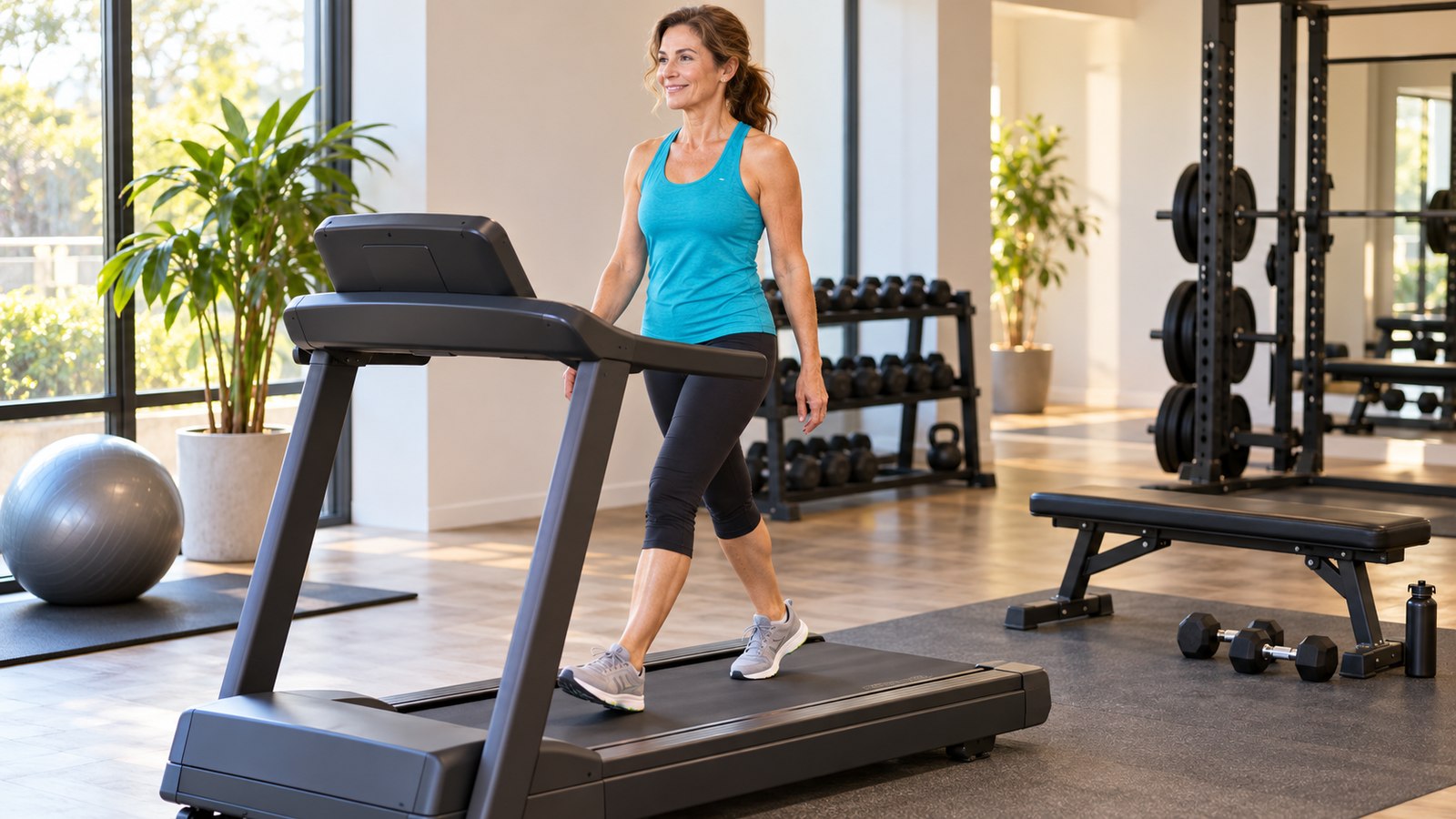
Session 2: the brisk walk. The Minnesota Bariatric Center lists brisk walking as zone 2 cardio. Walk 20–30 minutes, and slow down if your heart rate goes above your row.
These are two kinds of session, not your weekly total. Alternate them to reach the three to four sessions a week the Minnesota Bariatric Center suggests.
Later: the ruck walk. A ruck walk is a walk with weight on your back. BodySpec’s version lasts 40–60 minutes, with a backpack or weighted vest loaded to 10–20 pounds. Even its shortest version is 40 minutes, so it sits on rung 3, after the starter sessions. A backpack you already own will do.
A weighted vest is the other option BodySpec names.
If you have balance trouble: check with your provider before you add the ruck walk, as the MedlinePlus note at the top advises. Until then, you can stick to the bike, BodySpec’s option without joint impact.
Same fat loss when calories match; zone 2 can take about twice the minutes
HIIT is short, hard bursts of effort with rests in between. When total calories burned are matched, HIIT and steady moderate cardio give similar fat loss in many studies, according to PNOE. Note the wording: “many studies,” not all of them. The evidence leans toward a tie but doesn’t settle it.
The catch is time. PNOE estimates that a 20-minute HIIT session can burn as many calories as “perhaps a 40-minute Zone 2 jog.” That is one example estimate, not a rule. If it holds for you, zone 2 needs about twice the session time to match what HIIT burns.
Choose zone 2 if you can spare the 40 minutes. On the bike, it gives you continuous effort without joint impact, per BodySpec.
HIIT saves time, but the effort is high. PNOE puts its hard intervals at 80–100% of maximum heart rate. Samitivej Hospitals says zone 5, at 90–100%, is not advisable for people who are not well-trained athletes, and lists dizziness, fainting, raised blood pressure and possibly a heart attack. So if your week is packed, check with your provider before you choose HIIT.
Until then, zone 2 stays the default.
Related reading: Before You Accept Muscle Loss After 40.
FAQ
Can women use the age table? Yes. The women’s columns use Samitivej’s women’s formula, 209 − (0.7 × age). Find your age and read the last two columns.
Can a lab test replace the age formula? PNOE’s guide says tools like its own PNOĒ can “personalize your cardio.” The age table is the free place to start. A tool like that is optional.
Does zone 2 have to be cycling or walking? No. Any steady activity that keeps you in your row counts. PNOE’s own comparison uses a zone 2 jog.
Before you start: check with your health care provider
Take your table row to the provider visit the note at the top recommends, and ask whether the range suits you. Then start with the 20–30 minute bike ride.
Not medical advice. This is general information from public health sources.
Sources
- https://mnbariatrics.com/zone-2-cardio-the-key-to-sustainable-weight-loss-and-metabolic-health/
- https://www.samitivejhospitals.com/article/detail/heart-rate-zones
- https://www.bodyspec.com/blog/post/zone_2_cardio_for_fat_loss
- https://pnoe.com/blog/metabolic_health/best-cardio-for-fat-burn-and-endurance/
- https://medlineplus.gov/exerciseandphysicalfitness.html