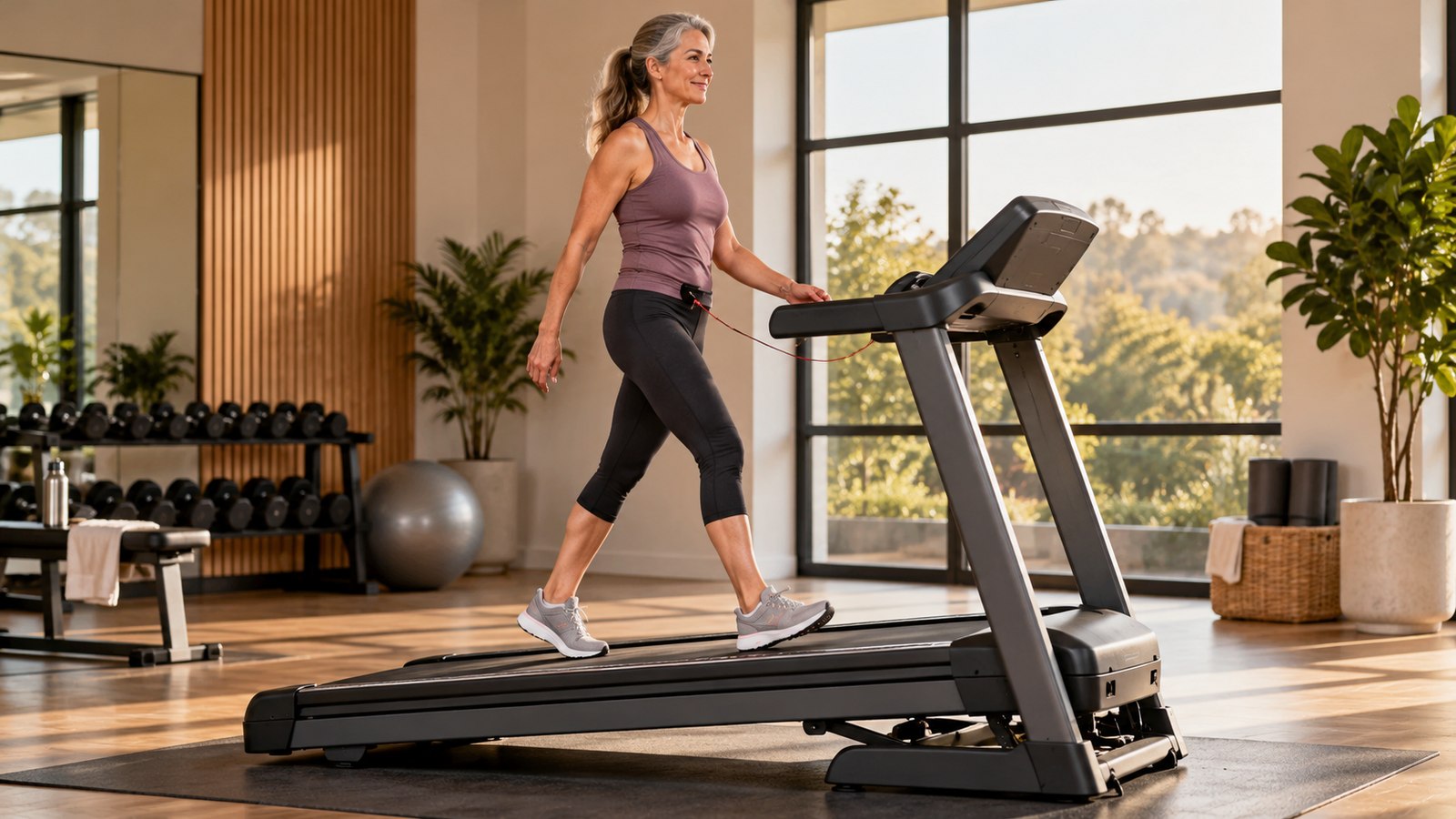
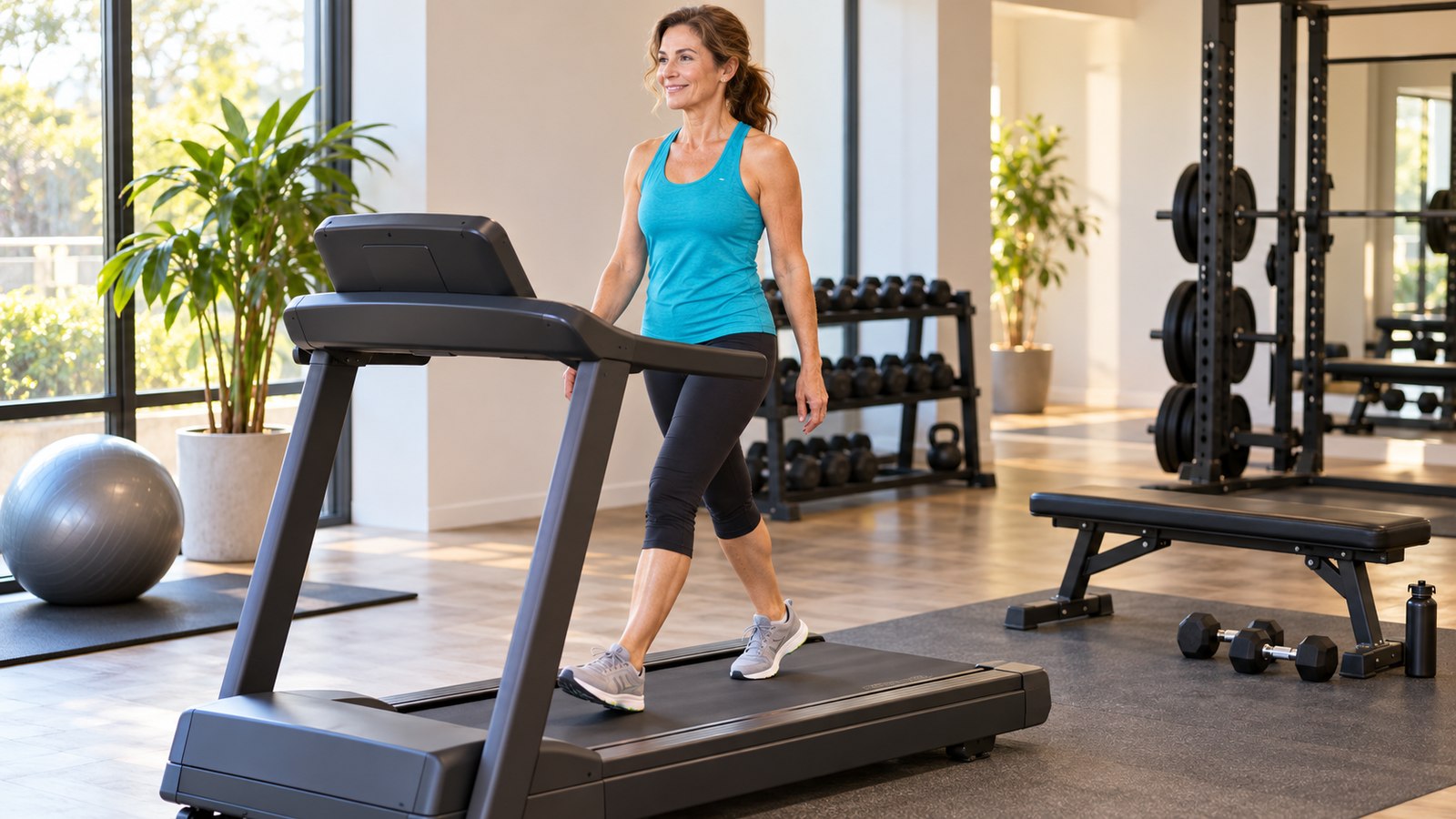
Zone 2 Cardio After 40: The Heart-Rate Range You Can Check by Talking
Zone 2 is 60-70% of your maximum heart rate, which works out to about 102-119 bpm at age 50. No monitor needed: if you can still speak in full sentences, keep going; if you are down to a few words at a time, slow down.

Zone 2 is easy, steady cardio you can still talk through.
In numbers, the five-zone guide from EoS Fitness puts it at 60-70% of your maximum heart rate. In words, Defined Fitness says your breathing and heart rate rise, but you can still speak in full sentences for most of the session. Both checks work. The talk test needs no equipment, so start with it.
Before you start a new routine, MedlinePlus advises you to “check with your health care provider, especially if you have trouble moving, balancing, or worry that exercise might not be safe.”
Zone 2 is the second of five zones, and it stops at 70% of max heart rate
According to Defined Fitness, many training plans use five effort zones. Zone 1 is very easy and zone 5 is close to your max. Zone 2 is one step above very easy.
The top of zone 2 is a set number. The EoS guide puts zone 3 at 70-80% of maximum heart rate (MHR, the fastest your heart can beat). So 70% is where zone 2 ends and harder work starts.
The “cardio” part is simple. The National Institute on Aging (NIA) says aerobic activity raises both your breathing and your heart rate. Zone 2 keeps both raised and steady, well short of your limit.
Two ways to know you’re in zone 2: use the talk test first and the heart-rate range second
The talk test. Defined Fitness puts it this way: “your heart rate and breathing will pick up, but you can still talk in full sentences for most of the workout.” The NIA gives a clearer upper limit. If you can hold a conversation “easily,” the effort is moderate. If you can “only say a few words,” it has become vigorous.
The full-sentence rule, then: if you can speak in full sentences, keep going. If you are down to a few words at a time, slow down.
The heart-rate range. The EoS guide estimates max heart rate as “220 – Your Age,” then takes 60% and 70% of that number. Here is the maths for four ages:
| Age | Estimated max (220 − age) | Zone 2 floor (max × 0.60) | Zone 2 ceiling (max × 0.70) |
|---|---|---|---|
| 40 | 180 bpm | 108 bpm | 126 bpm |
| 50 | 170 bpm | 102 bpm | 119 bpm |
| 60 | 160 bpm | 96 bpm | 112 bpm |
| 70 | 150 bpm | 90 bpm | 105 bpm |
Age 50 worked through, using the EoS formula: 220 − 50 = 170 bpm estimated max; 170 × 0.60 = 102 and 170 × 0.70 = 119, so zone 2 is about 102-119 bpm.
Each check has a weak spot. Every number in that table comes from a formula, not a measurement of your heart, so the beats per minute (bpm) are estimates. Defined also sets zone 2 against an “estimated max heart rate.” The talk test is your own judgment, and NIA’s version separates moderate from vigorous effort rather than marking the 70% line.
But the talk test needs no watch or chest strap, and the sources below that give an in-session check all describe a pace you can talk at. So use the talk test as your main check. If you already wear a heart-rate monitor, add the ceiling from the table, and slow down if you go over it.

Light, moderate or mild? Only the EoS zone chart says “light”; the other sources say moderate
The disagreement is smaller than it first looks. The EoS zone chart labels zone 2 “Light Intensity,” but the same article’s text calls it “a moderate-intensity workout” and the “conversational” pace. Defined says moderate. Cleveland Clinic says both “relatively mild” and “moderate-intensity aerobic exercise.”
| Source | How it describes this effort | Check it gives | Example activity or weekly amount |
|---|---|---|---|
| EoS Fitness | “Light Intensity” (zone chart); “moderate-intensity workout,” the “conversational” pace (article text) | 60-70% of MHR, with MHR = 220 − age | Brisk walking, light jogging, steady cycling |
| Defined Fitness | “Moderate intensity” | Full sentences for most of the workout | Two to three zone 2 sessions a week toward 150 minutes |
| Cleveland Clinic | “Relatively mild” and “moderate-intensity aerobic exercise” | Brisk walk = a mile on flatter ground in 15 to 20 minutes | Brisk walk; slow run two to three minutes slower than race pace |
| NIA | Aerobic activity, split into moderate and vigorous | Talk “easily” = moderate; “only say a few words” = vigorous | Brisk walking, building to at least 150 minutes a week |
The labels differ, but every check points to the same steady effort you can talk through. Without a monitor, you can use the bottom three rows with nothing more than your voice and a flat mile.
Brisk walking, light jogging and steady cycling all count, if you can still talk
The EoS guide lists brisk walking, light jogging and steady cycling as zone 2 examples. Cleveland Clinic puts a number on “brisk”: a mile on flatter ground in 15 to 20 minutes. For runners, it puts a slow run at about two to three minutes slower than race pace.
How hard you work matters more than which activity you pick. A steep hill can push a walk above zone 2. A flat route can keep a gentle jog inside it. Pick whichever you can repeat several times a week.
Research links zone 2 to endurance and an aerobic base, and that research is still building
Cleveland Clinic says “a growing body of research” links relatively mild zone 2 exercise to “significant health and fitness benefits.” The EoS guide names three benefits: better endurance, more fat oxidation (the body using fat as fuel) and “a solid aerobic base.”
Defined Fitness puts a number on two of them. In one study, a moderate-intensity group “improved VO2 max by about 10% in six weeks” (VO2 max: how well your heart, lungs and muscles use oxygen). In a 10-week supervised program at each person’s “max fat oxidation” intensity, fat oxidation rose “from 0.38 to 0.45 grams per minute.”
“Growing” means the research is still coming in, and each figure comes from a single study. This page makes no promise about body weight.
Before you start after 40: talk to your provider, show up regularly and build toward 150 minutes a week
Who should skip this routine for now: anyone the MedlinePlus note at the top describes, such as people with trouble moving or balancing. See your provider first. Ask about balance exercises, which MedlinePlus says “improve your stability and coordination,” and lighter movement: NIA says “even light-intensity movement can be beneficial.”
A starter routine, beginning easy:
- Pick one activity on flat ground. Walking is the simplest place to start from the EoS list. Cleveland Clinic’s 15-to-20-minute mile gives you a pace to aim for.
- Warm up and cool down. NIA’s guidance for older adults includes both in aerobic sessions. Start and finish slower than your main pace.
- Stay at talking pace. Follow the full-sentence rule above and, with a monitor, your ceiling from the table.
- Start short and regular. MedlinePlus says to “show up regularly, even for short sessions, to help you continue to make progress.”
- Add time and sessions gradually. NIA says to “gradually build up to at least 150 minutes” of moderate-intensity aerobic activity, such as brisk walking, each week. Defined suggests two to three zone 2 sessions a week toward that total.
For more on this topic, see the Training and strength guides.
Related reading: What Is Zone 2 Cardio Heart Rate Over 40; Zone 2 Cardio for Fat Loss After 40.
FAQ
Why does the EoS chart call zone 3 “moderate”? The EoS chart uses “Moderate Intensity” for zone 3 (70-80% of MHR), even though the article’s own text calls zone 2 moderate. So go by the checks, not the label.
My watch says I’m over my ceiling, but I can still talk in full sentences. Which one is right? They can disagree because the bpm range starts from an estimate. Slow down until both checks agree: under your ceiling and passing the full-sentence rule above.
Is zone 2 enough on its own? No. The NIA says “it’s important to get all three types: aerobic, muscle-strengthening, and balance.” So add strength work with weights, resistance bands or your own body weight, as MedlinePlus lists, plus some balance work.
When should I check with a clinician? Before you start, if the note at the top applies to you. During training, NIA says aerobic activity “should not cause dizziness, chest pain or pressure, or nausea.” If a session brings on any of these, stop and check with a clinician before your next one.
Not medical advice: This page summarizes public health and fitness sources for general information.
Sources
- https://www.eosfitness.com/blog/guide-zone-2-cardio
- https://defined.com/what-is-zone-2-cardio/
- https://health.clevelandclinic.org/zone-2-cardio
- https://www.nia.nih.gov/health/exercise-and-physical-activity/four-types-exercise-can-improve-your-health-and-physical
- https://medlineplus.gov/exerciseandphysicalfitness.html