Before You Buy a Heart-Rate Monitor: How Much Zone 2 Cardio Per Week
The American Heart Association recommends at least 150 minutes a week of moderate cardio, and every zone 2 minute counts toward it. If you are already fit, two sessions of 30 to 40 minutes cover 40% to 53% of that, leaving 70 to 90 minutes to add.

Aim for 150 minutes of moderate cardio per week (AHA, via Cleveland Clinic).
Zone 2 sessions count toward that total, so the real question is how much to start with. If you are already somewhat or very fit, the usual starting point is two zone 2 sessions of 30 to 40 minutes (Men’s Health). That gives you 60 to 80 minutes, or 40% to 53% of the 150, so you have 70 to 90 left to add.
If you are newer to cardio, our suggestion is to start with just two 30-minute sessions at a pace you can talk through. Add a brisk weekend walk once those feel easy.
The last section covers when to check with a clinician.
Zone 2 is the pace where you can still hold a conversation
Zone 2 is a steady, easy-to-moderate effort, and you don’t need a gadget to find it. Cleveland Clinic says that if you can carry on a light conversation while you move, you are probably in zone 2.
The same test tells you when you have pushed too hard. If all you can get out is yes or no, Men’s Health says you have usually climbed to zone 4 or 5. If you can speak in full sentences, hold that pace. If you’re down to one-word answers, slow down until the sentences come back.
150 minutes a week is the general target, and zone 2 minutes count toward it
The number comes from the American Heart Association (AHA). As Cleveland Clinic reports, the AHA recommends at least 150 minutes a week of moderate-intensity aerobic activity. Zone 2 falls in that moderate category, so every zone 2 minute counts toward the 150.
That is a general adult target, not one written for people over 40. MedlinePlus notes that how much exercise a person needs depends on their age and health.
Zone 2 still gets attention after 40, and here’s why. Men’s Health explains that with age, mitochondria (the parts of cells that turn fuel into energy) become “sparse, damaged, and inefficient.” It quotes Kenneth Jay: “Zone 2 cardio basically helps build your mitochondria.” Take that as the reason for the habit, not a promise of a particular result.
Fit adults: the minimum is two sessions of 30 to 40 minutes
For people who are somewhat or very fit, Men’s Health reports that experts typically recommend at least 30 to 40 minutes of zone 2 twice a week. Defined Fitness suggests 2 to 3 sessions a week as a practical first goal. One of its sample weeks is two 30-minute sessions plus a longer weekend walk.
There’s a catch: Men’s Health aims that minimum at people who already have some fitness. If you can’t keep talking through a 30-minute session, the answer is a slower pace, not pushing through. Slow down until you pass the talk test. Our suggestion is to stay at two 30-minute sessions at that pace before you add a walk.
Start with two zone 2 sessions a week at a pace you can talk through, then add minutes until the week reaches 150.
Who should skip this plan: anyone training for an endurance event. Men’s Health gives endurance athletes a different guideline: 80 percent of total training volume in zone 2. Tour de France winner Tadej Pogačar spends 80% of his training days in zone 2, according to his coach, as reported by INSCYD. The two 80% figures count different things.
One is a share of training volume, the other a share of training days. Neither is a weekly-minutes target for someone fitting cardio around a job. If you are training for an event, follow the Men’s Health 80%-of-volume guideline, or your coach’s plan, instead of the 150-minute arithmetic below.
Two sessions cover 40-53% of 150: add 70 to 90 minutes
Gap = 150 min target (AHA, via Cleveland Clinic) − 2 × 30 to 40 min (Men’s Health) = 150 − 60 to 80 = 70 to 90 minutes to add each week. Since 60/150 = 40% and 80/150 = 53%, the two sessions already cover 40% to 53% of the target.
You can close that gap three ways: a long walk, longer sessions, or more sessions. The table works out each one, using the session lengths from Men’s Health and Defined Fitness.
| Week | Arithmetic | Minutes | Share of 150 |
|---|---|---|---|
| Two 30-min sessions | 2 × 30 | 60 | 40% |
| Two 40-min sessions | 2 × 40 | 80 | 53% |
| Two 30-min sessions + brisk weekend walk | 60 + 90 | 150 | 100% |
| Two 40-min sessions + brisk weekend walk | 80 + 70 | 150 | 100% |
| Three sessions (top of Defined Fitness’s 2-to-3 range) | 150 ÷ 3 = 50 each | 150 | 100% |
| Five 30-min sessions (beyond Defined Fitness’s range) | 5 × 30 | 150 | 100% |
The middle rows show the trade-off. Stretching your weekday sessions from 30 to 40 minutes shortens the weekend walk you need from 90 minutes to 70. A third session of 50 minutes means you don’t need the long walk at all.
The walk only counts if it is brisk. Cleveland Clinic describes a brisk walk as about a mile in 15 to 20 minutes on flatter ground. It says a stroll around the neighborhood is zone 1 and “won’t get the job done.” Check your walking pace with the talk test.
Sample weeks: start at 60 to 80 minutes and build to 150
Move to the next step only when you can pass the talk test through the whole of the current one.
Newer to cardio (our suggested path)
- Start with two 30-minute weekday sessions at talk-test pace. Add nothing else yet.
- Add a weekend walk at brisk pace (see the pace under the table). That matches one of Defined Fitness’s sample weeks.
- Stretch the weekday sessions toward 40 minutes, the top of the Men’s Health range, and lengthen the walk until the week adds up. With two 40-minute sessions, a 70-minute brisk walk makes 150 (80 + 70).
This path tops out at three sessions a week. You never add a fourth.
Already somewhat or very fit
- Start at the Men’s Health minimum: 60 to 80 minutes over two sessions.
- Add a third session. That keeps you inside Defined Fitness’s 2-to-3 range.
- Build all three sessions toward 50 minutes each (3 × 50 = 150). If you can’t fit a third weekday session, keep two 40-minute sessions and add a 70-minute weekend walk at brisk pace instead.
Related reading: Zone 2 Cardio After 40; Before You Copy Peter Attia’s Zone 2 Cardio.

FAQ
How long should zone 2 exercise last?
Aim for 150 minutes a week in total. Any of the 150-minute rows in the table above gets you there.
Do I need a heart-rate monitor?
No, and the sources show why. Cleveland Clinic and Defined Fitness put zone 2 at 60% to 70% of your maximum heart rate. Men’s Health puts it at about 70% to 80%. So a monitor set to one range could tell you you’re out of zone 2 at a heart rate the other source calls zone 2.
The talk test needs no device and sidesteps the 60-70% vs 70-80% disagreement.
Is a brisk walk fast enough?
Yes, if it is truly brisk. Cleveland Clinic lists brisk walking as a zone 2 option. Use the pace under the table, then check it with the talk test: if you can carry on a light conversation, you are in zone 2.
Bad weather? A treadmill, bike, elliptical or rower lets you do zone 2 indoors
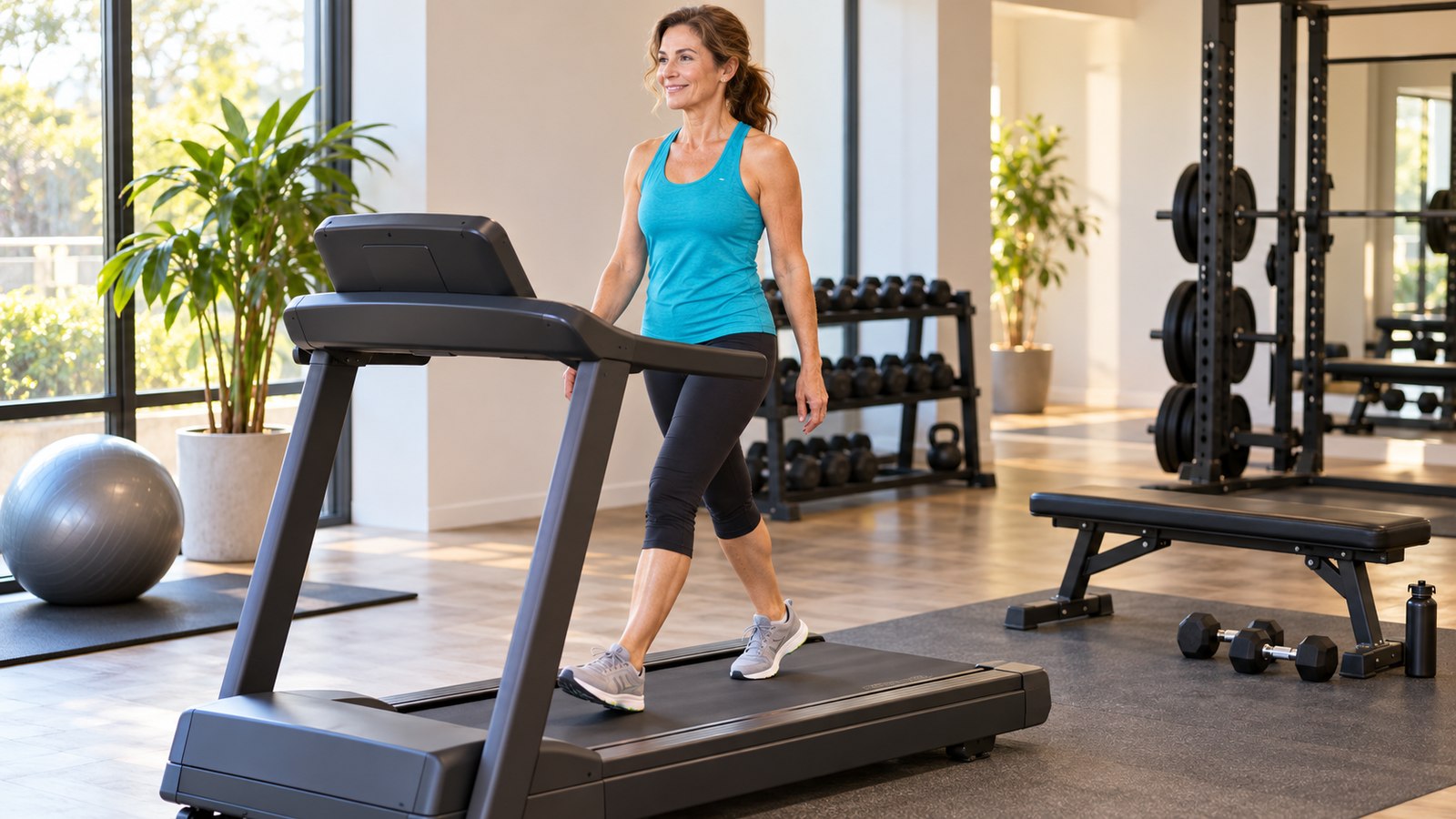
MedlinePlus lists a treadmill, a stationary bike and a workout video as options for indoor cardio. Cleveland Clinic includes elliptical and rowing machine workouts in its list of zone 2 options. The talk test works the same way on all of them, so pick the one you will actually use. The minutes count toward the same weekly total.
For more on this topic, see the Training and strength guides.
When to check with a clinician
MedlinePlus suggests talking with your health care provider about exercise, especially if you have trouble moving or balancing, or worry that exercise might not be safe for you. Take the numbers on this page with you. The 150-minute target and the two-session start are general figures, and a clinician can tell you how they fit your own health.
This is general information from public health sources, not medical advice.