Can Sarcopenia Be Reversed After 40? Partly – Here's Which Part
Partly: health sources agree strength training and protein slow age-related muscle loss and rebuild some of it, but one says lost fibers don't grow back. Loss runs about 3-8% a decade from age 30, so habits built at 40 still count.
All eight sources in this review back exercise, and most add protein or diet. Where they split is how much lost muscle comes back. Sarcopenia is the slow loss of muscle mass and strength that comes with age, and it can be reversed in part. The sources below show which part.
Short Answer: Slowed and Partly Rebuilt, Not Fully Undone
Cleveland Clinic says the right exercise and nutrition plan can “slow or even reverse” sarcopenia’s effects. Chaban Medical is more cautious: “Not completely — lost muscle fibers don’t grow back.” Both can be true, because the pages use “reverse” for different things.
Some pages mean strength and mass you can win back. Bupa says exercise can help you “rebuild any you’ve lost,” and FunctionSmart says “targeted exercise can rebuild lost muscle.” Chaban means the fibers themselves. Note that Chaban’s page also sells its own Just Walk device.
- Verdict: Cleveland Clinic says you begin losing muscle mass and strength “in your 30s or 40s,” so at 40 the advice already applies. The sources point to strength training, and most pair it with protein or diet. Expect to regain strength and some muscle, not every lost fiber.
- The flaw: None of the sources defines “reverse,” and only Chaban says what it rules out: lost fibers growing back. So a page that says “reversible” can promise more than it means. Fix: Track what you can measure, such as the load you lift, instead of waiting for one word to settle it.
- Strengths: All eight pages back exercise, and three give doses in numbers.
- Skip the self-start if: any sign in the box below fits you. See a clinician before you follow the steps here.
When to talk to a clinician: The Alliance for Aging Research lists five symptoms. They are falling, muscle weakness, slow walking speed, self-reported muscle wasting and “difficulty performing normal activities of daily living.” Bupa describes how they can show up: it’s “harder to climb the stairs without stopping,” or you notice muscle wastage on your legs, buttocks or arms. If any of these fits you, raise it with your doctor.
Muscle Loss Runs 3-8% a Decade, Then Speeds Up
Two sources give the same starting rate. Chaban Medical puts loss at 3-8% of muscle per decade after 30. It says the rate doubles after 70. FunctionSmart gives the same 3-8% figure but says losses speed up after 60.
If the 3-8% rate holds from 40 to 70, it compounds over three decades. At 3% a decade, you keep about 91% of your muscle (0.97 × 0.97 × 0.97). At 8%, you keep about 78%. That’s roughly 9-22% gone by 70, before Chaban’s doubling begins.
Other pages put the rate lower or the speed-up later. Harvard Health gives 3-5% per decade from 30. Cleveland Clinic says loss can reach “as much as 8%” a decade. It says the process “picks up between the ages of 65 and 80.”
Pounds are easier to picture than percentages. Harvard Health puts the loss at 4-6 pounds a decade for people who don’t strength-train. The last part of that sentence matters most: it ties the loss to whether you train.
Bupa separates normal aging from the condition. From about 60, some loss of muscle density is normal, but with sarcopenia the loss happens faster. So most sources put the start at about 30. They disagree on when it speeds up, which falls anywhere from 60 to 80 depending on the page.
Source by Source: Eight Agree Exercise Helps, Only Chaban Says Not Completely
This table puts each page’s own words on reversal beside the age it flags. Rows run from the strongest promise to the most cautious. A dash means no age is quoted from that page here.
| Source | Its own words | Reads as | Age it flags |
|---|---|---|---|
| OA Text | “A healthy diet and reasonable exercise can reverse sarcopenia” | Reverse | — |
| Cleveland Clinic | “slow or even reverse its effects” | Reverse | 65-80, loss “picks up” |
| Bupa | “good habits can help reverse it”; “rebuild any you’ve lost” | Reverse, rebuild | About 60, normal loss begins |
| FunctionSmart | “targeted exercise can rebuild lost muscle” | Rebuild | 60, losses speed up |
| PubMed Central article | “limit the occurrence and severity of sarcopenia” | Limit | — |
| Harvard Health | “slow its progression” | Slow | 30, 3-5% a decade begins |
| Alliance for Aging Research | “help slow” | Slow | 65, monitoring starts |
| Chaban Medical | “Not completely — lost muscle fibers don’t grow back” | Not completely | 70, rate doubles |
Read down the third column and the split is plain. Seven pages say slow, limit, rebuild or reverse, and only Chaban says not completely. Every row backs exercise, food or both.
Ask to Be Monitored From 65, Sooner If a Sign Fits
The Alliance for Aging Research says that if you’re 65 or older, your healthcare provider should be monitoring you for sarcopenia. If you’re younger, any sign in the box above is your cue to bring it up.
Bupa’s line gives that conversation a frame. Some loss from about 60 is normal, so the useful question is whether yours is moving faster. Bring what you track, such as the weights you lift, so the talk starts from your own record.
The Dose Starts at Two Strength Sessions a Week
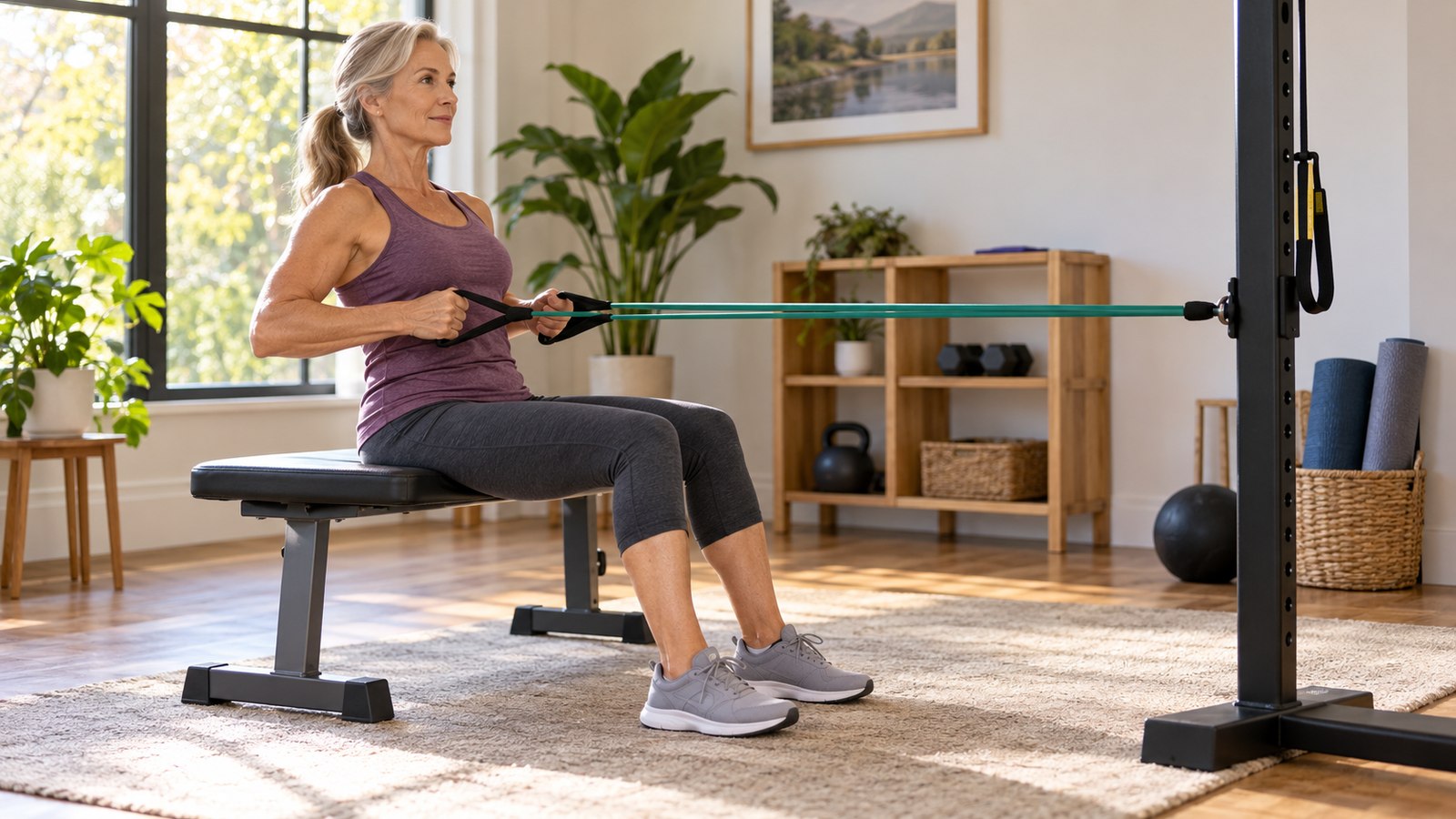
Three sources give numbers you can act on. Resistance training means making your muscles work against a weight, a band or your own body.
| Source | Who it’s for | Exercise | Protein |
|---|---|---|---|
| Bupa | People with sarcopenia | 150 minutes a week and two resistance sessions | 20-40 g per meal |
| Chaban Medical | Older adults | 150-200 minutes a week of resistance training | 1.2-1.6 g per kg of body weight a day |
| OA Text | Aging adults, for physical function | Resistance exercise alongside the diet | 1.0-1.3 g per kg of body weight a day |
The ranges don’t line up neatly. Chaban’s protein range starts at 1.2 g per kg. OA Text’s starts at 1.0 g. Bupa counts per meal rather than per day, which makes it the easiest figure to check at the table.
If you weigh 80 kg, here’s what those figures come to. OA Text’s range comes to 80-104 g of protein a day. Chaban’s comes to 96-128 g. If you eat three meals, Bupa’s 20-40 g per meal comes to 60-120 g.
Harvard Health adds power training, which “focuses on both strength and speed,” and says a mix of the two is ideal. It also says “You’re never too old to benefit” from strength and power training.
If you’re starting from zero, here’s a way in built on those sources:
- If you’ve never strength-trained or have a chronic condition, talk to your doctor, as Harvard Health advises.
- Book two resistance sessions a week, the number Bupa gives. Stairs, squats, sit-ups, weightlifting and gardening all count, per Bupa.
- Build up to the weekly minutes in the table slowly, as Bupa advises if you’re not used to exercise.
- Make the work harder over time. Chaban says progressive training is a must.
- Mix strength and power training, the combination Harvard Health calls ideal.
- Put protein in each meal, using Bupa’s per-meal range as your check.
The table can’t tell you which range fits you. The sources give ranges for groups, and a clinician can set a figure around your own health. For protein worked out by body weight, see protein per day for women over 40.
See also: Strength Training Over 40 Book: See the $0 Version.
Next step: Muscle Loss After 40: See How Much Is Still Ahead
FAQ: Can Sarcopenia Be Reversed?
Can Lost Muscle Come Back After 60?
Some of it can. Chaban Medical says resistance training brings strength gains of 10-30% and “measurable muscle growth even in 90-year-olds.” It says functional gains, such as faster walking and fewer falls, are routine within 12-24 weeks.
Those figures come from Chaban, which sells the Just Walk device, and rest on “dozens of randomized trials” the page does not name. The same page says lost fibers don’t grow back.
Does Sarcopenia Affect Women Too?
Yes. Harvard Health says sarcopenia affects men and women equally, so nothing here is a men-only plan.
Can Diet Alone Reverse It?
No source here says diet alone does it. OA Text names diet in its title, but its text says “A healthy diet and reasonable exercise can reverse sarcopenia.” Its protein figure also comes with resistance exercise. The PubMed Central article covers “dietary and exercise interventions” together.
This article summarizes public health sources and is not medical advice. Check with a clinician before you start a new strength or diet plan, and sooner if you have a health condition or notice any sign listed above.
Sources
- https://my.clevelandclinic.org/health/diseases/23167-sarcopenia
- https://www.chaban-medical.com/sarcopenia-exercises-for-elderly
- https://functionsmart.com/the-use-it-or-lose-it-truth-reversing-age-related-muscle-loss/
- https://www.health.harvard.edu/healthy-aging-and-longevity/a-guide-to-combatting-sarcopenia-and-preserving-muscle-mass-as-you-get-older
- https://www.bupa.co.uk/care-services/life-in-a-bupa-care-home/sarcopenia
- https://www.agingresearch.org/aging-health/sarcopenia/
- https://pmc.ncbi.nlm.nih.gov/articles/PMC10487983/
- https://www.oatext.com/sarcopenia-reversible-by-diet.php