Before You Buy Creatine Powder: What Foods Naturally Contain It
Among meat and fish, herring leads at about 1.25 g of creatine per 4-ounce serving, roughly 2.5 times beef, while cod and shrimp trail far behind. Matching a 3 g daily dose from food alone takes about 9.6 oz of herring or 1.5 lb of beef.
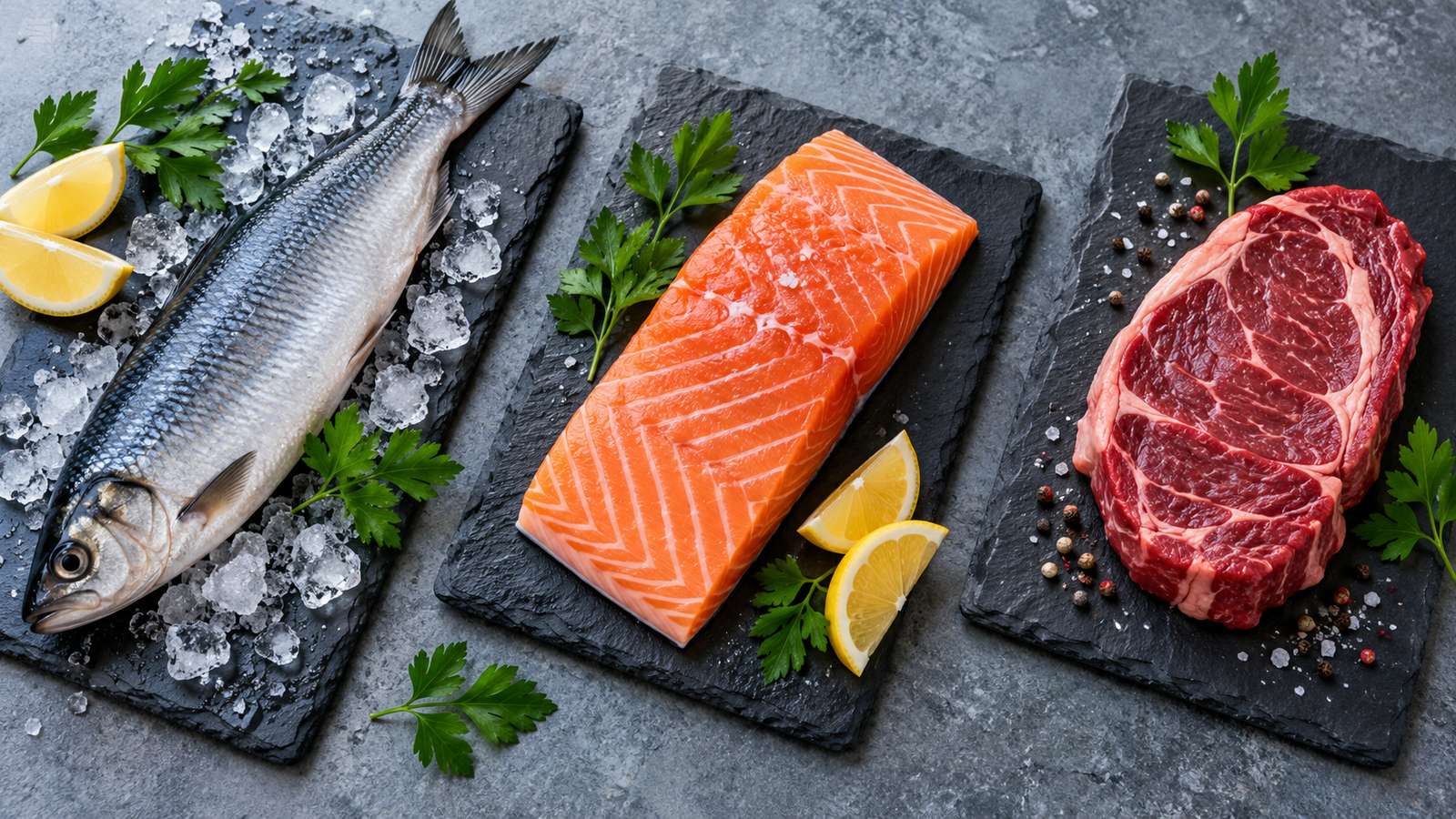
Meat and fish can cover part of a daily creatine dose, but the portions run large. That’s the short answer to what foods naturally contain creatine. Health.com puts herring at 1.25 grams (g) per 4-ounce (oz) serving, the top figure among the meats and fish ranked here.
Take 3 g a day as the target. Herring alone gets you there with 9.6 to 16.3 oz, depending on the source. Beef takes about 1.5 lb.
The short verdict
- Who food works for: If you eat fish and meat, food gives you real creatine. Herring does it in the smallest portion of the meats and fish ranked here.
- The limit, and its fix: Reaching 3 g from food alone takes a large daily portion, as the table below shows. A supplement closes the gap, or so does a creatine-fortified food, meaning a food with creatine added to it.
- What food does well: The creatine comes inside meals you already eat, with no product to buy.
- Who should skip the food-only route: Vegetarians, vegans and anyone who won’t eat those portions every day. A fortified food or a supplement fits them better.
Creatine in Food Comes Almost All From Meat and Fish Muscle
Creatine is stored in muscle, so the foods that carry it are the muscle of animals and fish. A PubMed Central (PMC) paper says dietary creatine comes “primarily from animal-source foods.”
PMC is the National Library of Medicine’s archive of journal articles. The paper is a 2025 editorial in the journal Public Health Nutrition, by Sergej M. Ostojic of the University of Pecs in Hungary.
Your body also makes its own. Everyday Health puts that at 1 to 2 g a day. It also says 3 to 5 g a day is the amount typically shown to help athletic performance. That’s why this page uses 3 g, the low end, as its yardstick.
It’s a point of comparison, not a daily requirement.
Dairy is the exception worth knowing. Dr. Berg says dairy holds far less creatine than meat and fish, except parmesan at about 2.9 g per 100 g. Dr. Berg’s page is written by its editorial team and approved by Eric Berg, a Doctor of Chiropractic (D.C.).
That is the only dairy figure in these sources, so the table lists it on its own row.
Herring Holds 2.5x Beef’s Creatine; Salmon Only Ties It
Per 4 oz of food, the published figures rank like this:
- Herring, 1.25 g, per Health.com, which gives it as an “up to” figure. Verywell Health gives 6.5 to 10 g per kilogram (kg). Dr. Berg gives 1.7 g per 6 oz.
- Pork, 0.57 g, per Health.com.
- Beef, 0.5 g, per Everyday Health. As a cross-check, Dr. Berg says a 6-oz (170 g) serving of beef holds around 750 milligrams (mg). That’s the same 0.5 g per 4 oz.
- Salmon, up to 0.5 g, per Health.com, so at best it ties beef.
- Bluefin tuna, 0.45 g, per Health.com.
- Cod, 0.35 g, per Everyday Health. That’s its 1.4 g per pound (lb) divided by 4. Verywell Health gives 3 to 4.4 g per kg. It puts a serving at “around 0.2 g.”
- Chicken breast, 0.2 to 0.3 g. Verywell Health gives 0.3 g per 6-oz breast. Dr. Berg gives 450 mg per 6 oz.
- Shrimp, about 0.08 g, worked out from Verywell Health’s figure of about 0.7 g per kg.
Lamb and mutton stay off the list. Verywell Health gives them 0.3 to 1.3 g per 4 oz. That range is too wide to rank: its top sits just above herring’s figure, its bottom below cod’s.
So which fish on this list beats beef? Only herring. Salmon ties it at best, tuna and cod fall short, and shrimp barely registers.
Reaching 3 g Takes 9.6 oz of Herring or 1.5 lb of Beef
The table puts every source’s figure on one scale, grams per 4 oz of food, then divides 3 g by it. Health.com’s herring figure and Everyday Health’s beef figure are both for raw food, so weigh portions raw to match them.
| Food | Creatine per 4 oz | Source figure and conversion | Amount for 3 g |
|---|---|---|---|
| Herring | 1.25 g | Health.com: up to 1.25 g per 4 oz, raw | 9.6 oz |
| Herring (other pages) | 0.74 to 1.13 g | Verywell Health: 6.5 to 10 g per kg × 0.1134 kg; Dr. Berg: 1.7 g per 6 oz ÷ 1.5 | 10.6 to 16.3 oz |
| Pork | 0.57 g | Health.com: 0.57 g per 4 oz | 21.1 oz |
| Beef | 0.5 g | Everyday Health: 0.5 g per 4 oz; Dr. Berg: 750 mg per 6 oz ÷ 1.5 | 24 oz (1.5 lb) |
| Salmon | up to 0.5 g | Health.com: up to 0.5 g per 4 oz | 24 oz or more |
| Bluefin tuna | 0.45 g | Health.com: 0.45 g per 4 oz | 26.7 oz |
| Cod | 0.35 g | Everyday Health: 1.4 g per lb ÷ 4 | 34.3 oz |
| Chicken breast | 0.2 to 0.3 g | Verywell Health: 0.3 g per 6 oz ÷ 1.5; Dr. Berg: 450 mg per 6 oz ÷ 1.5 | 40 to 60 oz |
| Shrimp | 0.079 g | Verywell Health: 0.7 g per kg × 0.1134 kg | 4.29 kg (about 9.4 lb) |
| Parmesan (dairy, one source) | 3.29 g | Dr. Berg: 2.9 g per 100 g × 1.134 | 3.6 oz |
Three checks the sources don’t do for you:
- Herring vs beef = 5 g per lb ÷ 2 g per lb = 2.5x, both figures from Health.com. Dr. Berg’s own pair gives 1.7 g ÷ 0.75 g per 6 oz = 2.3x. Verywell’s low herring end against Everyday Health’s beef gives 0.74 g ÷ 0.5 g = 1.5x.
- Cod = 1.4 g per lb from Everyday Health ÷ 0.4536 kg per lb = 3.1 g per kg. That’s inside the 3 to 4.4 g per kg range from Verywell Health, so the two sources agree.
- Verywell’s 0.2 g cod serving = 0.2 g ÷ 3 to 4.4 g per kg = 45 to 67 g. That’s about 1.6 to 2.4 oz, smaller than the 4 oz used here.
Read down the last column. Among the meats and fish, herring needs the smallest portion, even at its low end. Pork comes next at 21.1 oz. Shrimp would take about 9.4 lb.
Plan with herring’s low end: 16.3 oz for 3 g. Health.com’s 1.25 g is an “up to” figure, and the other two pages come in lower. Parmesan needs only 3.6 oz, but that figure rests on one page.
Food can still cover part of the yardstick. One 4-oz herring portion supplies 1.25 g ÷ 3 g = 42% of it at the top figure. At the low end, it’s 0.74 g ÷ 3 g = 25%.
Swap one 4-oz beef dinner for herring and the day gains 0.24 to 0.75 g. That’s herring’s 0.74 or 1.25 g, minus beef’s 0.5 g.
No Plant Food Makes These Lists, So Vegetarians and Vegans Come Up Short
Dr. Berg says creatine “is mainly found in the muscle meat of animal products.” Its vegan list, from pumpkin seeds to chickpeas, covers the amino acids the body uses to make creatine, not creatine itself.
The PMC paper says low creatine status “may be widespread, particularly among vegetarians, vegans, older adults.”
If you eat no meat or fish, you have two options. The first is what your body makes on its own. The second is a fortified food or a supplement.
If you eat dairy, Dr. Berg’s parmesan figure is the one food option in these sources.
Food creatine is one piece of keeping muscle. The training side is covered in Can Sarcopenia Be Reversed After 40?
Fortified Foods Add 0.5 to 3 g per Serving, Up to the Full Yardstick
Fortified foods fill the gap that meals leave. A fortified food has creatine added to it. These products typically add 0.5 to 3 g per serving, according to the PMC paper. At the top of that range, one serving equals the 3 g yardstick. At the bottom, it matches one 4-oz portion of beef.
Read the grams per serving on the label and add it to what your meals supply. A herring dinner at 1.25 g plus a low-end fortified serving brings the day to 1.75 g.
Next step: See the protein and supplement guides in one place on the nutrition and supplements page.
Related reading: Before You Try Creatine to Help With Anxiety.
FAQ: What Foods Naturally Contain Creatine?
What foods naturally contain creatine? Mainly meat and fish, per the PMC paper, plus some dairy, per Dr. Berg; herring tops the meats and fish ranked here, per Health.com.
Do the numbers change once food is cooked? The table’s herring and beef figures are for raw food, per Health.com and Everyday Health, so weigh portions raw to match it.
Can a vegan reach 3 g from food? Not from the plant foods in these sources; a dietitian quoted by Everyday Health says plant-based eaters “may benefit from creatine supplementation.”
Not medical advice: This article summarizes published nutrition sources for general education. It does not replace advice from your own clinician.
Sources
- https://www.health.com/foods-with-creatine-11702732
- https://www.drberg.com/blog/foods-high-in-creatine
- https://www.everydayhealth.com/diet-nutrition/top-natural-sources-of-creatine-in-your-diet/
- https://www.verywellhealth.com/foods-high-in-creatine-11798561
- https://pmc.ncbi.nlm.nih.gov/articles/PMC12722096/